
Product Facts
- Product Name
- Selleys Aquadhere Exterior Wood Glue
- Availability
- In Stock
- Condition
- New
- Category
- Home & Garden > Adhesives & Glues
- Seller
- Selleys
- Color
- Off-white (dries clear/yellow tint)
- Material
- PVA (D3 exterior-grade)
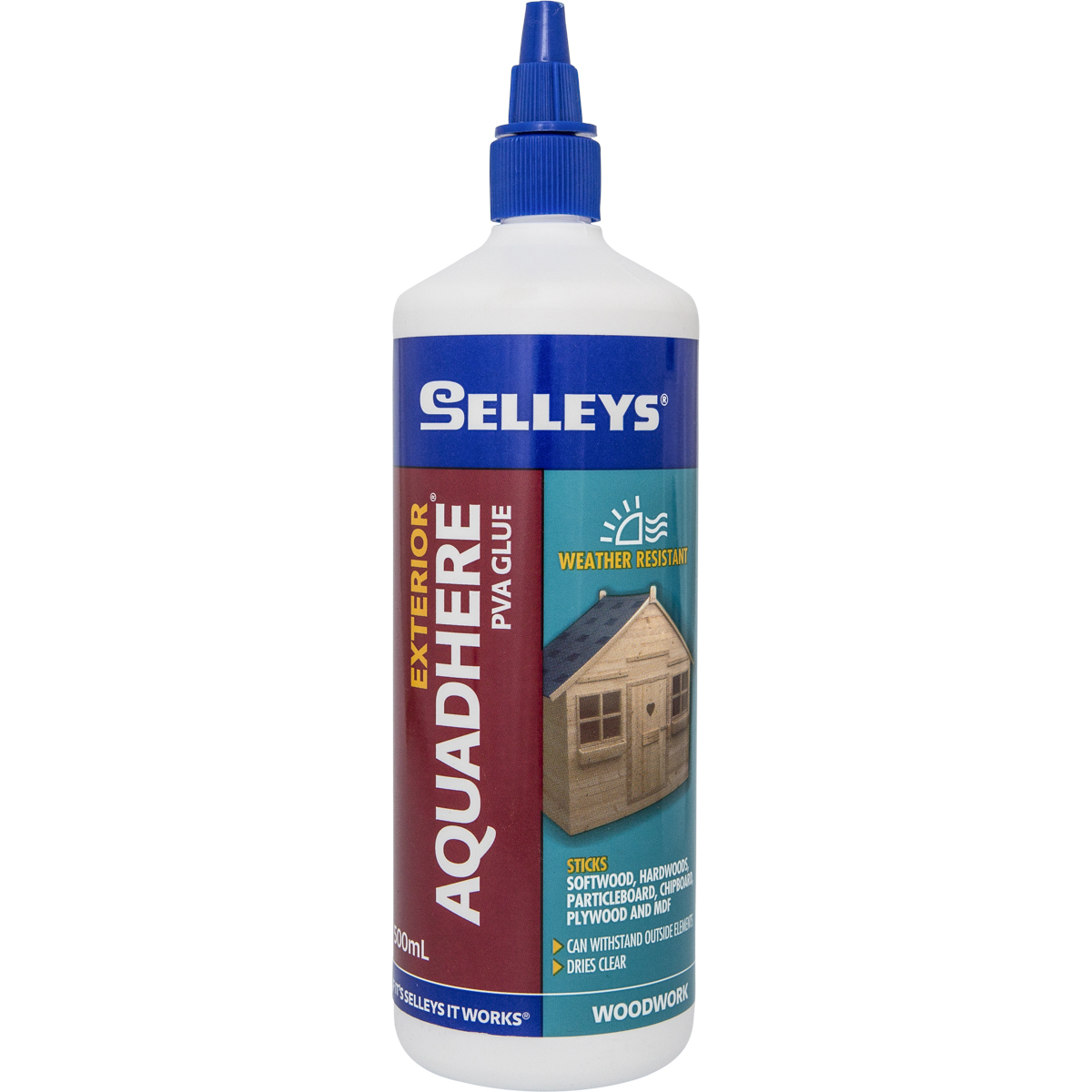
Selleys Aquadhere Exterior Wood Glue
Selleys Aquadhere Exterior Wood Glue. PVA (D3 exterior-grade) technology. COMPOSITION - Technology: PVA (D3 exterior-grade) PHYSICAL - Colour: Off-white (dries clear/yellow tint) PERFORMANCE - Coverage: 1 L covers approx. 5 m² APPLICATION - Suitable Substrates: Softwoods Hardwoods MDF Plywood Particleboard Chipboard LIMITATIONS / NOT SUITABLE FOR Not waterproof for immersion. Not suitable for coated/vinyl wallpapers. Not structural. Will not accept stain without sanding. DIRECTIONS FOR USE 1. Ensure joints are close-fitting and clean. 2. Apply liberally to one surface. 3. Clamp 30 min (softwood) to 1 hr (hardwood). 4. Do not stress for 24 hours. ADDITIONAL SPECIFICATIONS - Maximum Strength Time: ~24 hours
AI Summary
Product: Selleys Aquadhere Exterior Wood Glue Brand: Selleys Category: Exterior Woodworking Adhesive Primary Use: Water-based polymer emulsion adhesive for bonding timber assemblies in outdoor and high-humidity environments where bonds must withstand cyclic wetting, UV exposure, and temperature variation.
Quick Facts
- Best For: Woodworkers and joiners bonding timber for pergolas, outdoor furniture, decking components, covered patios, and window or door joinery with weather exposure
- Key Benefit: Delivers a durable, moisture-resistant bond through aluminium chloride hexahydrate crosslinking that resists re-dissolution when wetted, without hazardous solvents or VOC emissions
- Form Factor: Viscous white emulsion; ready-to-use with no mixing required
- Application Method: Apply by brush, spreader, or direct bead to clean dry timber; clamp until cured
Common Questions This Guide Answers
- Is Aquadhere Exterior safe to use indoors without special ventilation? → Yes — it is non-hazardous under Australian GHS 7, releases only water vapour during cure, and natural ventilation is sufficient for typical applications
- How long does it take to fully cure and when can clamps be removed? → Lightly loaded joints can be unclamped after several hours; structural joints require 24 hours minimum clamping; full cure takes 7 days before maximum load or weather exposure
- What happens if the adhesive freezes or overheats in storage? → Freezing causes irreversible emulsion separation rendering the product unusable; elevated temperatures accelerate crosslinking, increasing viscosity until the material becomes unworkable
What Selleys Aquadhere Exterior Wood Glue Is
Selleys Aquadhere Exterior is a water-based woodworking adhesive built for exterior applications where bonded timber assemblies face real weather exposure (SELLEYS_AQUADHERE_EXTERIOR-AUS_GHS.pdf). Interior wood glues break down under moisture. This formulation holds up through cyclic wetting, UV exposure, and temperature swings typical of outdoor environments. The product comes ready-to-use in four container sizes — 250 mL, 500 mL, 1 L, and 4 L — so both hobbyist woodworkers and professional joiners can pick the right volume for the job (SELLEYS_AQUADHERE_EXTERIOR-AUS_GHS.pdf).
This adhesive belongs on timber that lives outdoors or in high-humidity environments: covered patios, pergolas, outdoor furniture, decking components, and window or door joinery with weather exposure. The exterior classification means the glue's polymer structure is engineered to resist hydrolysis and hold cohesive strength through repeated moisture cycling. When you need it to last, this is the product.
Chemistry and formulation
The adhesive is built around a polymer emulsion system with aluminium chloride hexahydrate as a functional component at 1–10% by weight (SELLEYS_AQUADHERE_EXTERIOR-AUS_GHS.pdf). This aluminium salt acts as a crosslinking catalyst, accelerating the formation of covalent bonds between polymer chains as the emulsion dries. That crosslinking transforms the initially flexible polymer film into a three-dimensional network that resists re-dissolution when wetted — the core requirement for exterior-grade adhesive performance.
The water-based carrier means no volatile organic solvents. During application and cure, only water vapour is released. That removes the flammable vapour hazards and strong odours that come with solvent-based contact adhesives or polyurethane formulations. The material is not classified as hazardous under Safe Work Australia GHS 7 criteria, and carries no Poison Schedule designation (SELLEYS_AQUADHERE_EXTERIOR-AUS_GHS.pdf). That non-hazardous classification reflects the absence of regulated hazardous substances above threshold concentrations, though the aluminium salt component still calls for standard industrial hygiene practices during handling.
The product is classified as a combustible material (SELLEYS_AQUADHERE_EXTERIOR-AUS_GHS.pdf). The high water content prevents ignition under normal conditions, but dried polymer residue will burn if exposed to sufficient heat. This combustibility rating shapes storage requirements and emergency response procedures without restricting typical workshop use.
Physical properties and handling characteristics
Aquadhere Exterior is a viscous white emulsion. The consistency allows application by brush, spreader, or direct bead from the container, depending on joint geometry and required coverage. It flows at application viscosity without thinning, and excess material cleans up from tools and skin with water before the adhesive sets.
The material creates slip when spilled on smooth surfaces (SELLEYS_AQUADHERE_EXTERIOR-AUS_GHS.pdf). Clean up any dropped adhesive immediately — particularly on concrete workshop floors or sealed timber surfaces where the liquid film removes friction. That cleanup matters beyond safety too: spilled adhesive that dries on adjacent surfaces forms a tough film that requires mechanical removal.
Temperature drives both application performance and storage stability. Store the product in a cool, dry, well-ventilated location away from direct sunlight and heat sources (SELLEYS_AQUADHERE_EXTERIOR-AUS_GHS.pdf). Freezing disrupts the emulsion structure, causing permanent separation of the polymer and water phases that renders the adhesive unusable. High storage temperatures accelerate the slow crosslinking reactions that occur even in sealed containers, gradually increasing viscosity and eventually causing gelation that blocks normal application.
Application methods and joint preparation
Surface preparation begins with clean, dry timber substrates free from oils, waxes, or previous finishes that block adhesive wetting. Freshly machined or sanded timber gives you the ideal bonding surface. Weathered or contaminated surfaces need mechanical preparation to expose clean wood.
Apply adhesive to one or both mating surfaces depending on timber porosity and joint design. Open-grained hardwoods or end-grain joints perform best with double-sided application to ensure adequate adhesive penetration into wood cellular structure. Edge-grain joints in softwoods or medium-density species typically need application to one surface only. Spread the adhesive evenly for complete coverage without excessive squeeze-out — thick glue lines reduce ultimate bond strength.
Assembly must happen while the adhesive remains wet and tacky. Water-based emulsions begin forming a surface skin as water evaporates, reducing the adhesive's ability to wet and penetrate the second substrate. Position components accurately during initial assembly. The slip characteristic of wet adhesive allows minor adjustments immediately after bringing surfaces together.
Clamping pressure does three things: it maintains component alignment during cure, ensures intimate contact between adhesive and wood surfaces, and forces excess adhesive from the joint. Apply enough pressure to produce a thin visible squeeze-out bead along the joint line — that confirms complete glue-line coverage. Excessive clamping force starves the joint of adhesive and creates a weak bond. For most applications, finger-tight clamps on cabinet joints or moderate bar clamp pressure on edge-glued panels delivers the right force.
Cure profile and strength development
The adhesive cures through a multi-stage process that starts when water evaporates from the applied film. Initial tack develops within minutes as water concentration drops and polymer particles begin coalescing. This early stage provides the handling strength that allows clamp removal, but it represents only a fraction of ultimate bond performance.
Full strength development requires continued moisture loss and completion of the crosslinking reactions catalysed by aluminium chloride hexahydrate (SELLEYS_AQUADHERE_EXTERIOR-AUS_GHS.pdf). This process extends over days, shaped by ambient temperature, relative humidity, glue-line thickness, and wood species permeability. Dense tropical hardwoods with closed grain structure retain moisture longer than porous softwoods, which extends cure times.
Minimum clamp time varies with joint stress and service conditions. Lightly loaded joints can be unclamped after several hours when the adhesive has developed enough green strength to handle stresses. Structural joints need to stay clamped for a minimum of 24 hours, with full cure occurring over 7 days before subjecting assemblies to maximum design loads or weather exposure.
Temperature has a significant effect on cure rate. Cool conditions below 10°C slow water evaporation and chemical crosslinking, potentially extending full cure to two weeks or more. Warm shop temperatures of 20–25°C optimise cure kinetics. Avoid artificially heating clamped assemblies — rapid surface drying can trap moisture in the glue line, creating internal stresses that undermine bond integrity.
Safety protocols and personal protection
Even with a non-hazardous classification under Australian GHS criteria (SELLEYS_AQUADHERE_EXTERIOR-AUS_GHS.pdf), standard industrial hygiene practices apply during handling and application. Wear safety shoes, overalls, gloves, and safety glasses (SELLEYS_AQUADHERE_EXTERIOR-AUS_GHS.pdf). This protection prevents direct skin and eye contact, which may cause irritation in sensitive individuals even when the material lacks formal hazard classifications.
Choose gloves that balance chemical resistance with the manual dexterity needed for precise adhesive application. Nitrile rubber gloves provide suitable protection for intermittent contact, though users must make final assessments based on glove construction and specific work conditions (SELLEYS_AQUADHERE_EXTERIOR-AUS_GHS.pdf). Disposable nitrile examination gloves work well for light-duty applications and allow frequent changes when adhesive contaminates outer surfaces. Reusable industrial nitrile gloves provide extended protection for production environments with continuous exposure.
If skin contact occurs despite protective measures, remove contaminated clothing immediately and flush affected skin and hair with running water (SELLEYS_AQUADHERE_EXTERIOR-AUS_GHS.pdf). Seek medical attention if swelling, redness, blistering, or persistent irritation develops (SELLEYS_AQUADHERE_EXTERIOR-AUS_GHS.pdf). The aluminium chloride component can cause irritation in prolonged contact situations, particularly if adhesive dries on skin and concentrates the salt.
Eye protection prevents splash exposure during application, especially when working overhead or dispensing from squeeze bottles. If eye contact occurs, wash immediately with water and continue irrigation while seeking medical advice (SELLEYS_AQUADHERE_EXTERIOR-AUS_GHS.pdf). Seek medical consultation for all eye contamination incidents regardless of symptom severity — corneal damage assessment requires professional evaluation.
Inhalation hazards are minimal under normal workshop ventilation conditions. Natural ventilation provides adequate air exchange for typical applications (SELLEYS_AQUADHERE_EXTERIOR-AUS_GHS.pdf). If respiratory irritation occurs, move the affected person from the area and provide fresh air (SELLEYS_AQUADHERE_EXTERIOR-AUS_GHS.pdf). Production environments with continuous adhesive use or heated curing systems may need enhanced ventilation to manage accumulated water vapour.
Always wash hands thoroughly before smoking, eating, drinking, or using toilet facilities (SELLEYS_AQUADHERE_EXTERIOR-AUS_GHS.pdf). This prevents incidental ingestion of adhesive residue. If ingestion occurs, rinse the mouth with water and give water to drink, but do not induce vomiting (SELLEYS_AQUADHERE_EXTERIOR-AUS_GHS.pdf). Seek medical advice, and provide the SDS or product container to inform treatment decisions (SELLEYS_AQUADHERE_EXTERIOR-AUS_GHS.pdf).
Storage requirements and container management
Store containers in a cool, dry, well-ventilated location away from direct sunlight and heat sources (SELLEYS_AQUADHERE_EXTERIOR-AUS_GHS.pdf). Keep storage areas separate from foodstuffs and incompatible materials (SELLEYS_AQUADHERE_EXTERIOR-AUS_GHS.pdf). This separation prevents contamination and reduces risks if a container releases material.
Keep containers standing upright with closures secured (SELLEYS_AQUADHERE_EXTERIOR-AUS_GHS.pdf). Upright storage prevents leakage from closures and keeps labels legible. Regular leak inspections identify container deterioration before significant material loss occurs (SELLEYS_AQUADHERE_EXTERIOR-AUS_GHS.pdf). Address damaged containers immediately by transferring contents to sound containers with proper labelling.
Avoid temperature extremes in storage. Freezing temperatures disrupt the emulsion, causing irreversible phase separation visible as watery supernatant over curdled polymer solids. Elevated temperatures accelerate crosslinking reactions in sealed containers, gradually increasing viscosity until the material becomes unworkable paste. Seasonal temperature cycling in uninsulated storage areas can produce both outcomes over annual cycles.
Partially used containers need extra attention. Air exposure starts surface skinning as water evaporates from the emulsion surface. Remove any formed skin before use rather than mixing it into the bulk adhesive — partially cured material contains aggregated polymer particles that create weak spots in bond lines. Keep air exposure to a minimum by selecting container sizes matched to project consumption rates, and transfer small quantities from large containers rather than opening bulk supplies repeatedly.
Emergency response and spill management
For small spills involving minor quantities suited to hand cleanup, wear protective equipment to prevent skin and eye contact (SELLEYS_AQUADHERE_EXTERIOR-AUS_GHS.pdf). Wipe up material with absorbent cloths or paper towels, collecting contaminated absorbents in sealed, properly labelled containers for disposal (SELLEYS_AQUADHERE_EXTERIOR-AUS_GHS.pdf). Clean residual adhesive from surfaces with water while the material remains wet — dried adhesive requires mechanical removal.
Large spills exceeding hand-cleanup capacity demand a more systematic response. Clear the area of unprotected personnel immediately (SELLEYS_AQUADHERE_EXTERIOR-AUS_GHS.pdf). The slip hazard on smooth surfaces creates serious injury risk until material is contained (SELLEYS_AQUADHERE_EXTERIOR-AUS_GHS.pdf). Response personnel must wear complete protective equipment including safety shoes, overalls, gloves, and safety glasses (SELLEYS_AQUADHERE_EXTERIOR-AUS_GHS.pdf).
Work upwind of spilled material or increase ventilation to prevent vapour accumulation in low areas (SELLEYS_AQUADHERE_EXTERIOR-AUS_GHS.pdf). Contain the spill to prevent flow into drains and waterways by constructing dikes from absorbent materials such as soil, sand, or commercial spill pads (SELLEYS_AQUADHERE_EXTERIOR-AUS_GHS.pdf). Absorb the bulk liquid, then collect contaminated absorbent in sealed, labelled drums for disposal (SELLEYS_AQUADHERE_EXTERIOR-AUS_GHS.pdf). If sewers, waterways, or agricultural areas have been contaminated, notify local emergency services immediately (SELLEYS_AQUADHERE_EXTERIOR-AUS_GHS.pdf).
The product is not classified as Dangerous Goods under Australian or New Zealand transport regulations (SELLEYS_AQUADHERE_EXTERIOR-AUS_GHS.pdf), and carries no Hazchem code or Initial Emergency Response Guide designation (SELLEYS_AQUADHERE_EXTERIOR-AUS_GHS.pdf). That non-regulated status simplifies transport and storage but does not remove the need for proper spill response procedures.
Fire safety considerations
Aquadhere Exterior is classified as a combustible material, but its high water content prevents ignition under normal handling conditions (SELLEYS_AQUADHERE_EXTERIOR-AUS_GHS.pdf). Fire risk is primarily a storage concern where containers face external fire sources. If the adhesive becomes involved in a fire, use water fog, fine water spray, alcohol-resistant foam, standard foam, dry chemical powder, or carbon dioxide as extinguishing agents (SELLEYS_AQUADHERE_EXTERIOR-AUS_GHS.pdf).
Burning or thermal decomposition of the polymer components may produce toxic fumes (SELLEYS_AQUADHERE_EXTERIOR-AUS_GHS.pdf). Firefighters responding to incidents involving this material must wear self-contained breathing apparatus and suitable protective clothing if exposure to vapours or combustion products is possible (SELLEYS_AQUADHERE_EXTERIOR-AUS_GHS.pdf). Decomposition products from polymer combustion typically include carbon monoxide, carbon dioxide, and various hydrocarbon fragments, all of which present inhalation hazards.
Storage area fire protection must account for the combustible classification. Maintain clear separation from ignition sources including welding operations, grinding equipment, and electrical installations that could produce sparks. Store away from oxidising materials or other substances that promote combustion. Fire-rated construction in storage areas adds protection in facilities holding multiple combustible materials.
Quality control and performance verification
Assess adhesive condition through visual inspection and application testing. Fresh, properly stored material appears as a uniform white emulsion without phase separation, lumps, or surface skin. Discard material showing yellowing, foul odours, excessive thickening, or separated liquids — these are clear signs of degradation that will undermine bond performance.
Periodic bond strength verification using scrap materials confirms adhesive effectiveness and correct application technique. Create test joints using the same timber species, joint configuration, and clamping procedures planned for production work. After full cure, subject test joints to destructive loading. Strong bonds produce wood fibre tearing rather than adhesive layer separation. Adhesive layer separation points to inadequate surface preparation, insufficient clamping pressure, premature clamp removal, or degraded adhesive.
For production environments, keep application records noting adhesive batch numbers, application dates, and ambient conditions. This documentation supports quality investigations if bond performance issues arise in service and helps establish shelf-life management protocols specific to your storage conditions.
Regulatory status and product codes
Selleys markets Aquadhere Exterior under multiple product codes corresponding to container sizes: 100013 (250 mL), 100014 (500 mL), 100016 (1 L), and 100015 (4 L) (SELLEYS_AQUADHERE_EXTERIOR-AUS_GHS.pdf). Each size carries distinct barcodes for retail scanning and inventory management (SELLEYS_AQUADHERE_EXTERIOR-AUS_GHS.pdf). Reference these codes when ordering supplies or contacting technical support to ensure accurate product identification.
The manufacturer, operating under ABN 67 000 049 427, maintains technical support through telephone 1300 555 205 (SELLEYS_AQUADHERE_EXTERIOR-AUS_GHS.pdf). Emergency assistance is available 24 hours through dedicated hotlines: 1800 220 770 in Australia and 0800 220 770 in New Zealand (SELLEYS_AQUADHERE_EXTERIOR-AUS_GHS.pdf). In poisoning incidents, contact the Poisons Information Centre at 131 126 in Australia or 0800 764 766 in New Zealand (SELLEYS_AQUADHERE_EXTERIOR-AUS_GHS.pdf).
Professional application considerations
Commercial woodworkers and joiners selecting exterior adhesives weigh performance requirements, application efficiency, and regulatory compliance. Aquadhere Exterior's water-based chemistry removes the workplace exposure controls required for isocyanate-based polyurethane adhesives or formaldehyde-releasing urea systems. The non-hazardous classification under Australian GHS criteria simplifies safety documentation and reduces regulatory reporting obligations (SELLEYS_AQUADHERE_EXTERIOR-AUS_GHS.pdf).
Production efficiency comes from matching adhesive properties to workflow requirements. The ready-to-use viscosity means immediate application with no mixing or conditioning steps, unlike one-component polyurethane or two-part epoxy systems that demand preparation time before you can get to work. The water-based cure mechanism does require clamp time planning, as fixtures remain occupied longer than with fast-cure reactive adhesives. Shops with limited clamping capacity may need to stagger production schedules or invest in additional fixtures to maintain throughput.
Quality assurance programmes in joinery facilities should establish moisture content specifications for timber substrates. Wood moisture above 15% introduces free water into bond lines, diluting the adhesive and extending cure times unpredictably. Conversely, extremely dry timber below 8% moisture content can pull water from the adhesive too quickly, preventing adequate penetration. Keep substrate moisture content between 8–12% for the best bonding results with water-based adhesives.
With over 80 years of proven performance behind it, Selleys Aquadhere Exterior gives both professionals and DIYers confidence to tackle outdoor timber projects knowing the bond will hold.
References
- Source PDF: SELLEYS_AQUADHERE_EXTERIOR-AUS_GHS.pdf (canonical)
Frequently Asked Questions
What is Selleys Aquadhere Exterior: A water-based exterior woodworking adhesive
Is Aquadhere Exterior suitable for outdoor use: Yes
Is Aquadhere Exterior suitable for indoor use: Yes, especially high-humidity environments
What type of adhesive chemistry does it use: Polymer emulsion system
What is the crosslinking agent in the formula: Aluminium chloride hexahydrate
What percentage of aluminium chloride hexahydrate is in the formula: 1–10% by weight
Does it contain solvents: No, it is water-based
Does it release volatile organic compounds during cure: No
What does the water-based carrier release during cure: Water vapour only
Is Aquadhere Exterior classified as hazardous under Australian GHS: No
Does it have a Poison Schedule designation: No
Is it classified as a combustible material: Yes
Can it ignite under normal handling conditions: No, high water content prevents ignition
What makes dried adhesive residue a fire risk: It will burn if exposed to sufficient heat
What container sizes are available: 250 mL, 500 mL, 1 L, and 4 L
What is the product code for the 250 mL size: 100013
What is the product code for the 500 mL size: 100014
What is the product code for the 1 L size: 100016
What is the product code for the 4 L size: 100015
What colour is the adhesive: White
What is the physical form of the adhesive: Viscous emulsion
Can it be applied by brush: Yes
Can it be applied by spreader: Yes
Can it be applied directly from the container: Yes
How do you clean up wet adhesive from tools: With water
Does spilled adhesive create a slip hazard: Yes, on smooth surfaces
What surfaces are most at risk from adhesive spills: Concrete floors and sealed timber surfaces
What happens to dried spilled adhesive: It forms a tough film requiring mechanical removal
Should adhesive be applied to one or both surfaces: Depends on timber porosity and joint design
When should double-sided application be used: For open-grained hardwoods or end-grain joints
When is single-sided application sufficient: Edge-grain joints in softwoods or medium-density species
What surface condition is ideal for bonding: Clean, dry, freshly machined or sanded timber
Can adhesive be applied to oily or waxed surfaces: No, these block adhesive wetting
Must assembly happen while adhesive is wet: Yes
Can minor adjustments be made after surfaces are joined: Yes, immediately after assembly
What does correct clamping pressure produce: A thin visible squeeze-out bead along the joint line
Does excessive clamping pressure improve bond strength: No, it starves the joint and weakens the bond
What is the minimum clamp time for lightly loaded joints: Several hours
What is the minimum clamp time for structural joints: 24 hours
How long until full cure is achieved: 7 days
Does temperature affect cure rate: Yes, significantly
What is the optimal shop temperature for curing: 20–25°C
What happens to cure time below 10°C: Extends full cure to two weeks or more
Should clamped assemblies be artificially heated to speed cure: No
Why should artificial heating be avoided during cure: Rapid surface drying traps moisture in the glue line
What happens if the adhesive freezes: Permanent emulsion separation, rendering it unusable
What happens to adhesive stored at high temperatures: Viscosity increases, eventually causing gelation
How should containers be stored: Upright with closures secured
Where should the adhesive be stored: Cool, dry, well-ventilated location
Should it be stored near foodstuffs: No
Should it be stored near direct sunlight: No
What PPE is recommended for handling: Safety shoes, overalls, gloves, and safety glasses
What glove material is recommended: Nitrile rubber
Are disposable nitrile gloves suitable for light-duty use: Yes
What should you do if skin contact occurs: Flush with running water immediately
Should contaminated clothing be removed after skin contact: Yes, immediately
When should you seek medical attention after skin contact: If swelling, redness, blistering, or irritation develops
What should you do if eye contact occurs: Wash immediately with water and seek medical advice
Should all eye contamination incidents receive professional evaluation: Yes
Are inhalation hazards significant under normal conditions: No
Is natural ventilation sufficient for typical applications: Yes
What should you do if respiratory irritation occurs: Move to fresh air
Should hands be washed before eating or smoking: Yes
What should you do if adhesive is ingested: Rinse mouth, give water to drink
Should vomiting be induced after ingestion: No
What emergency number handles poisoning in Australia: 131 126
What emergency number handles poisoning in New Zealand: 0800 764 766
What is the 24-hour Australian emergency hotline: 1800 220 770
What is the 24-hour New Zealand emergency hotline: 0800 220 770
What is the Selleys technical support phone number: 1300 555 205
What extinguishing agents are suitable for fires involving this product: Water fog, foam, dry chemical, or carbon dioxide
Do firefighters need breathing apparatus when tackling fires involving this product: Yes
What toxic hazard exists during combustion: Toxic fumes from polymer decomposition
What combustion by-products may be produced: Carbon monoxide, carbon dioxide, and hydrocarbon fragments
Is Aquadhere Exterior classified as Dangerous Goods for transport: No
Does it carry a Hazchem code: No
How should small spills be cleaned up: Wipe with absorbent cloths, collect in sealed labelled containers
What is the first step for large spills: Clear the area of unprotected personnel
How should spills near drains be managed: Contain with dikes of soil, sand, or spill pads
Who should be notified if waterways are contaminated: Local emergency services
What indicates fresh, usable adhesive: Uniform white emulsion without lumps or separation
What signs indicate degraded adhesive: Yellowing, foul odour, excessive thickening, or phase separation
What does a strong bond produce in destructive testing: Wood fibre tearing, not adhesive layer separation
What causes adhesive layer failure in destructive testing: Poor prep, insufficient pressure, or degraded adhesive
What is the ideal timber moisture content for bonding: 8–12%
What happens if timber moisture exceeds 15%: Adhesive dilutes and cure time extends unpredictably
What happens if timber is extremely dry below 8% moisture: Water is pulled from adhesive too quickly
Does the product require mixing before use: No, it is ready-to-use
Is it suitable for pergola construction: Yes
Is it suitable for outdoor furniture: Yes
Is it suitable for window and door joinery: Yes, where weather exposure exists
Is it suitable for decking components: Yes
Is it suitable for covered patios: Yes
What is the manufacturer's ABN: 67 000 049 427
How long has Aquadhere Exterior been proven in the market: Over 80 years
Label Facts Summary
Disclaimer: All facts and statements below are general product information, not professional advice. Consult relevant experts for specific guidance.
Verified label facts
Product identity
- Product name: Selleys Aquadhere Exterior
- Manufacturer ABN: 67 000 049 427
- Source documentation: SELLEYS_AQUADHERE_EXTERIOR-AUS_GHS.pdf
Product codes and container sizes
- 250 mL — Product code: 100013
- 500 mL — Product code: 100014
- 1 L — Product code: 100016
- 4 L — Product code: 100015
Formulation
- Adhesive type: Water-based polymer emulsion
- Physical form: Viscous white emulsion
- Crosslinking agent: Aluminium chloride hexahydrate at 1–10% by weight
- Solvent content: None (water-based carrier only)
- VOC emissions during cure: None; releases water vapour only
Regulatory and hazard classification
- Hazardous substance classification (Safe Work Australia GHS 7): Not classified as hazardous
- Poison Schedule designation: None
- Combustibility classification: Classified as a combustible material
- Dangerous Goods classification (Australian/New Zealand transport): Not classified
- Hazchem code: None
- Initial Emergency Response Guide designation: None
Recommended personal protective equipment
- Safety shoes, overalls, gloves, and safety glasses
- Glove material: Nitrile rubber (suitable for intermittent contact per available information)
First aid — skin contact
- Remove contaminated clothing immediately
- Flush affected skin and hair with running water
- Seek medical attention if swelling, redness, blistering, or persistent irritation develops
First aid — eye contact
- Wash immediately with water
- Continue irrigation while seeking medical advice
- Seek medical consultation for all eye contamination incidents
First aid — inhalation
- Move affected person from area and provide fresh air
First aid — ingestion
- Rinse mouth with water; give water to drink
- Do not induce vomiting
- Seek medical advice; provide SDS or product container to inform treatment
Ventilation requirements
- Natural ventilation is sufficient for typical applications
Storage requirements
- Store in a cool, dry, well-ventilated location
- Keep away from direct sunlight and heat sources
- Keep away from foodstuffs and incompatible materials
- Store containers upright with closures secured
- Inspect regularly for leaks
Fire response
- Suitable extinguishing agents: Water fog, fine water spray, alcohol-resistant foam, standard foam, dry chemical powder, carbon dioxide
- Firefighters must wear self-contained breathing apparatus and suitable protective clothing if exposed to vapours or combustion products
- Burning or thermal decomposition may produce toxic fumes
Spill response — small spills
- Wear full PPE
- Wipe up with absorbent cloths or paper towels
- Collect contaminated absorbents in sealed, properly labelled containers for disposal
Spill response — large spills
- Clear area of unprotected personnel immediately
- Work upwind or increase ventilation
- Contain spill using dikes of soil, sand, or commercial spill pads to prevent entry into drains and waterways
- Absorb bulk liquid; collect in sealed, labelled drums for disposal
- Notify local emergency services if sewers, waterways, or agricultural areas are contaminated
Emergency contact numbers
- Selleys technical support: 1300 555 205
- 24-hour Australian emergency hotline: 1800 220 770
- 24-hour New Zealand emergency hotline: 0800 220 770
- Australian Poisons Information Centre: 131 126
- New Zealand Poisons Information Centre: 0800 764 766
Hygiene requirements
- Wash hands thoroughly before smoking, eating, drinking, or using toilet facilities
General product claims
- Suitable for exterior applications including pergolas, outdoor furniture, covered patios, decking components, and window or door joinery with weather exposure
- Suitable for high-humidity interior environments
- Bond resists cyclic wetting, UV exposure, and temperature variation
- Polymer structure engineered to resist hydrolysis under repeated moisture cycling
- Crosslinking chemistry produces a three-dimensional polymer network that resists re-dissolution when wetted
- Minimum clamp time for lightly loaded joints: several hours
- Minimum clamp time for structural joints: 24 hours
- Full cure achieved over 7 days before subjecting assemblies to maximum design loads or weather exposure
- Cure time may extend to two weeks or more below 10°C
- Optimal cure temperature: 20–25°C
- Artificial heating of clamped assemblies should be avoided as rapid surface drying may trap moisture in the glue line
- Freezing causes irreversible emulsion separation rendering the product unusable
- Elevated storage temperatures accelerate crosslinking, increasing viscosity and potentially causing gelation
- Ideal timber substrate moisture content for bonding: 8–12%
- Timber moisture above 15% dilutes adhesive and extends cure unpredictably
- Timber moisture below 8% may pull water from adhesive too quickly, preventing adequate penetration
- Double-sided application recommended for open-grained hardwoods and end-grain joints
- Single-sided application typically sufficient for edge-grain joints in softwoods or medium-density species
- Correct clamping pressure produces a thin visible squeeze-out bead along the joint line
- Excessive clamping pressure starves the joint of adhesive and reduces bond strength
- Strong bonds produce wood fibre tearing (not adhesive layer separation) under destructive testing
- Adhesive layer separation in destructive testing indicates inadequate surface preparation, insufficient clamping pressure, premature clamp removal, or degraded adhesive
- Degraded adhesive is indicated by yellowing, foul odour, excessive thickening, or phase separation
- Product marketed as having over 80 years of proven performance
- Non-hazardous classification simplifies safety documentation and reduces regulatory reporting obligations for professional users
- Ready-to-use formulation requires no mixing or conditioning steps
Related Products & Brand Context
Selleys Aquadhere Exterior Wood Glue sits within the Home & Garden > Adhesives & Sealants category, specifically in the wood glue segment. The "Aquadhere" name signals that this product belongs to Selleys' established Aquadhere wood glue range — a line built around PVA-based adhesive technology. This particular variant is the exterior-rated member of that family, distinguished from interior formulations by its weatherproof, water-resistant bond that holds up against outdoor conditions. Its intended applications include decks, fences, and other outdoor timber structures, and it is compatible with softwoods, hardwoods, MDF, plywood, particleboard, and chipboard.
The product is made by Selleys, an Australian adhesives and sealants brand whose catalogue spans a broad range of home repair and construction products. Within Selleys' range, Aquadhere Exterior occupies the outdoor woodworking niche — relevant to builders, DIYers, and tradespeople working with structural or decorative timber in exposed environments. While the available data does not enumerate every sibling product in the Aquadhere line, the naming convention ("Exterior" as a qualifier) strongly implies that an interior-grade counterpart exists within the same range.
For someone using Aquadhere Exterior on a project, several adjacent product categories are worth considering. Surface preparation is an important step before bonding timber outdoors — sanding materials and timber cleaners help ensure surfaces are free of dust, oils, and weathering residue that could weaken adhesion. Clamping tools or ratchet straps are also practically necessary, as the product requires sustained pressure during curing, with maximum bond strength reached at approximately 24 hours. For finishing the broader project, exterior timber coatings such as decking oils, stains, or sealers would typically follow the gluing stage. Because the glue dries clear with a slight yellow tint, it suits applications where glue lines may be partially visible after finishing.
Within the Adhesives & Sealants category, Aquadhere Exterior is differentiated by its combination of wood-specific formulation, weatherproof performance, and easy water clean-up — making it a practical choice for outdoor timber work where both durability and ease of use matter.
Product Data (OpenAI Spec)
View Full JSON Spec ↗Specifications
| Colour | Off-white (dries clear/yellow tint) |
|---|---|
| Coverage | 1 L covers approx. 5 m² |
| Technology | PVA (D3 exterior-grade) |
| Limitations | Not waterproof for immersion. Not suitable for coated/vinyl wallpapers. Not structural. Will not accept stain without sanding. |
| Directions for Use | 1. Ensure joints are close-fitting and clean. 2. Apply liberally to one surface. 3. Clamp 30 min (softwood) to 1 hr (hardwood). 4. Do not stress for 24 hours. |
| Suitable Substrates | Softwoods Hardwoods MDF Plywood Particleboard Chipboard |
| Maximum Strength Time | ~24 hours |
Product Intelligence
Selleys Aquadhere Exterior Wood Glue: Technical Details, Specifications, and Features
Overview
Selleys Aquadhere Exterior is an industrial-grade, weatherproof wood adhesive manufactured by Selleys, specifically engineered for professional woodworkers and craftsmen working on exterior and outdoor applications. It is formulated as a polyaliphatic cross-linking PVA (polyvinyl acetate) adhesive that produces bonds stronger than most timber species while maintaining excellent weather resistance.
Product Classification
Product Type: PVA (Polyvinyl acetate) water-based wood adhesive
Recommended Use: Woodworking glue for exterior applications
Technology: PVA polymer, water-based with D3 exterior-grade formulation
Physical Properties
| Property | Specification |
|---|---|
| Colour | Off-white, dries clear with yellow tinge |
| Odour | Characteristic |
| pH | 2–3 (acidic) |
| Density | 1.05 g/cm³ |
| Viscosity | 2000–3500 cP |
| Solubility | Dispersible/miscible in water |
| VOC Content | Low VOC (non-flammable) |
Curing & Performance Properties
| Property | Specification |
|---|---|
| Clamp Time (Softwoods) | 30 minutes minimum |
| Clamp Time (Hardwoods) | 1 hour minimum |
| Maximum Open Time | 24 hours |
| Full Cure Time | 7 days (longer in cold, damp conditions) |
| Bond Strength | Stronger than most timber species |
| Weather Resistance | Excellent—waterproof when cured |
| Coverage | Approximately 5 m² per litre |
Key Features & Benefits
Adhesive Performance
- Superior Bond Strength: Produces bonds stronger than most woods, making it ideal for demanding applications
- Weatherproof: Excellent exterior weather resistance when fully cured; forms waterproof bonds suitable for outdoor exposure
- Non-Toxic: Safe for use by professionals and in diverse applications, including around children's crafts
- Clear Drying: Dries clear with minimal visual impact on finished projects; transparent bond line with minimal creep
User Convenience
- Water-Based Formulation: Easy water cleanup of uncured product; non-flammable and safer than solvent-based alternatives
- Low Viscosity: Easily applied by brush, spreader, or dispenser
- Gap-Filling Properties: Good gap-filling capability (up to approximately 1–2 mm); can be mixed with sawdust for small gaps
- Acidic pH (2–3): Provides good penetration for dense hardwoods requiring deeper adhesive penetration
Post-Curing Workability
- Finishable: Can be sanded, routed, chiselled, or turned after curing
- Paintable: Suitable for painting or varnishing after application
- Re-softening Capability: Cured adhesive can be re-softened with steam or hot water if needed
Suitable Substrates
Primary Substrates
- Softwoods: Pine, fir, cedar, spruce
- Hardwoods: Oak, maple, ash, beech, Australian hardwoods (Merbau, Jarrah, Blue Gum)
Good Substrates
- Plywood
- Veneer
- Medium-Density Fibreboard (MDF)
Fair Substrates (Limited Suitability)
- Particleboard
- Chipboard
- Hardboard (absorption risk)
Additional Materials
- Polystyrene: Can be bonded to wood for exterior applications
NOT Suitable For
- Non-wood materials (metal, plastic, concrete—limited adhesion)
- Flexible substrates
- Below waterline applications or continuous submersion
- Applications where colour stability is critical (PVA slightly yellows over time)
Key Applications
Selleys Aquadhere Exterior is ideal for:
- Joinery & Woodworking: Dowelling, laminating, veneering, cabinet and furniture making
- Outdoor Construction: Decks, fences, pergolas, arbours, and gates
- Timber Framing: Exterior timber joinery and outdoor timber framing
- Furniture & Repairs: Garden furniture construction and repair, outdoor timber furniture restoration
- Boat Building: Marine plywood applications
- Joint Types: Mortise, tenon, dovetail, and other timber joint bonding
- Sheet Work: Lamination of timber sheets and veneers for exterior use
Packaging & Availability
| Packaging Type | Size |
|---|---|
| Bottle | 250 mL |
| Bottle | 500 mL |
| Bottle | 1 L |
| Bottle | 4 L |
Handling & Storage
Storage Requirements:
- Store in a cool, dry, well-ventilated place away from direct sunlight
- Store away from foodstuffs and incompatible materials
- Store away from sources of heat and ignition
- Keep container standing upright and tightly closed
Handling Precautions:
- Avoid eye contact and repeated or prolonged skin contact
- Avoid inhalation of vapour, mist, or aerosols
- Wear appropriate personal protection equipment (gloves, safety glasses) during handling, disposal, recycling, or reclamation
Surface Preparation & Application
- Surface Preparation: Surfaces must be close-fitting, dry, and clean
- Application: Shake bottle before use; apply adhesive liberally to one surface only
- Clamping: Clamp for 30 minutes (softwoods) or 1 hour (hardwoods); do not stress joint for 24 hours
- Cleanup: Wipe off excess adhesive with damp cloth while still wet
- Maximum Strength: Attained in 24 hours, but may be longer in cold, damp conditions or with dense timbers
Limitations & Warnings
- Not recommended for joints subjected to constant high stress (though longer clamping times may provide improvement)
- Avoid contamination with iron, steel, or other metals; rust oxidation causes brown/black staining
- Tannin staining: Woods containing tannins may cause brown/black discolouration when in contact with the adhesive
- Colour stability: PVA slightly yellows over time, potentially affecting appearance in light-coloured applications
- Not suitable for below waterline applications or continuous submersion
Hazard & Safety Classification
Hazard Status: Not classified as hazardous according to Safe Work Australia GHS 7 criteria
Dangerous Goods Status: Not classified as dangerous goods under:
- Australian Code for Transport of Dangerous Goods by Road & Rail
- New Zealand NZS5433: Transport of Dangerous Goods on Land
- IMDG Code (marine transport)
- IATA Dangerous Goods Regulations (air transport)
Poison Schedule: Not Applicable
Regulatory Compliance
- AICIS Status: All components listed or exempt from AICIS requirements
- New Zealand: All components listed on or exempt from the NZIoC (New Zealand Inventory of Chemicals)
- HSNO Classification: Classified under HSNO Group Standard HSR002658—Surface Coatings and Colourants (Corrosive) Group Standard 2020
Cleanup & Removal
- Uncured Product: May be easily removed with water
- Cured Product: Can be sanded or scraped for removal
- Recycling: Material and container should be recycled if possible before considering disposal
References
- [1] SELLEYS_AQUADHERE_EXTERIOR-AUS_GHS.pdf
- [3] selleys-aquadhere-exterior-tds.pdf
- [4] selleys-adhesives-tds-detailed.md
- [5] selleys_product_safety_technical_data.md
- [6] selleys-products-batch-10.md